Arctic Circle Assembly 2026: Security, Cooperation and the Future of the High North
In Reykjavík, strategic interests met questions of trust, climate responsibility and northern participation.
Sources
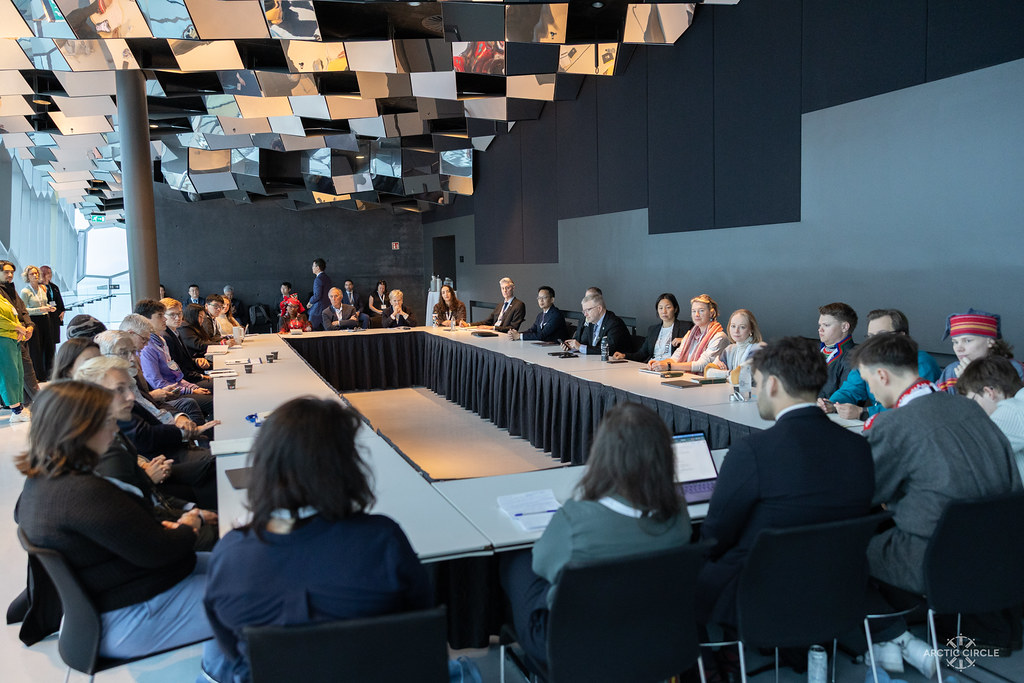
The 2026 Arctic Circle Assembly brought international attention to a region where security, environmental change and economic interests are increasingly intertwined. Held in Reykjavík at Harpa Concert Hall and Conference Centre and the Reykjavík EDITION, the Assembly featured approximately 700 speakers across more than 200 sessions. Its programme brought political representatives, researchers, Indigenous voices and business participants into discussions about the Arctic’s future.[1]
Security and Political Trust
A central question emerging from the conference was how cooperation can be sustained as strategic competition places greater pressure on regional relationships. Discussions extended beyond military capabilities to political trust, scientific access, resource governance and the consequences of development for northern communities. Taken together, these subjects suggest that Arctic security requires a broader assessment of the institutions and relationships on which regional stability depends.
Relations between Greenland, the United States and European partners were a prominent concern. In its account of the Assembly, the Fridtjof Nansen Institute reported discussions about NATO cohesion and the difficulty of rebuilding confidence after tensions over Greenland. Greenlandic politician Aaja Chemnitz emphasised the importance of practical action in restoring trust. FNI research director Andreas Østhagen also cautioned against allowing geopolitical rhetoric to obscure the different security challenges facing different parts of the Arctic.[2]
This distinction matters. Treating the Arctic as a single strategic space can conceal substantial differences between its communities, territories and political circumstances. A useful assessment must ask where a particular risk arises, whom it affects and which institutions are equipped to address it. Greater international attention is valuable when it leads to a more precise understanding of regional needs.

Climate Change as a Security Challenge
The relationship between climate change and security formed another important strand of the programme. Sessions addressed Arctic ice loss, the risks associated with changes in Atlantic ocean circulation, and the assessment of possible climate interventions. The published programme included discussion of the uncertainties, trade-offs and governance questions surrounding proposed responses to environmental change. These debates illustrate why scientific evidence and political accountability must be considered together when evaluating interventions with potentially far-reaching consequences.[3][4]
Indigenous Participation in Decision-Making
Indigenous participation is particularly important in this context. UArctic’s programme included a session on Indigenous and expert assessment of climate intervention, alongside discussions about research capacity and collaboration. Such questions concern who helps define research priorities, whose knowledge informs assessments, and how potential risks and benefits are evaluated. Meaningful participation should therefore be understood as part of decision-making itself, rather than simply representation within a conference programme.[4]
Critical Minerals and Local Priorities
Economic discussions similarly exposed the connection between international ambitions and local realities. FNI’s account of a session on critical minerals highlighted tensions between rapidly changing geopolitical priorities and the much longer timelines of mining projects. It also recorded concerns about the effects of new projects on local labour markets and essential services. The policy challenge is to assess investment through its environmental and social consequences as well as its strategic value.[2]
Scientific Cooperation and Arctic Research
Scientific cooperation offered a further perspective on the region’s future. In preparation for the Fifth International Polar Year, planned for 2032–33, the International Arctic Science Committee supported a session on developing an Arctic access programme. Its stated focus included research stations, vessels, data infrastructure and equitable access. This work points to a practical dimension of cooperation: maintaining the capacity to observe and understand the Arctic requires sustained institutional support.[5]
From Dialogue to Action
The Assembly’s discussions provide a basis for a broader conclusion: the Arctic’s growing strategic significance increases the need for careful, accountable policymaking. Security commitments, scientific cooperation, environmental responsibility and the priorities of northern communities must be considered together. The measure of progress will be how effectively the dialogue in Reykjavík translates into sustained cooperation and decisions that respond to the region’s distinct circumstances.