A place for friendly dialogue?
Original title: Ein Ort für freundschaftlichen Dialog?
An Arctic opening up as its ice retreats is changing the calculus of military operations and bringing the North Pole increasingly into focus as a potential arena of conflict.
For generations, seafarers searched for a Northwest Passage from Europe to Asia through the Arctic. Climate change has now exposed large parts of the polar region, and the ice along this route, coveted for centuries, is melting.
The Arctic Ocean is now in focus not only because of consistently high or rising global demand for raw materials and hopes for shorter, more economical freight routes between East and West, but particularly because of various actors’ military ambitions.
The United States and its allies are concerned about their long-term defence, the five Arctic coastal states are asserting territorial claims, and interest from non-Arctic states such as China and India is growing.
The possibilities for reaching common ground are discussed each year through the Arctic Security Series. The Munich Security Conference regularly organises these Arctic Security Roundtables to address current debates and security challenges surrounding the Arctic.
‘It is essential that we remain actively engaged in the region—particularly with Arctic allies and partners, where all Arctic nations regularly conduct military training and exercises,’ Munich Security Conference Chairman Ambassador Ischinger said at this year’s Roundtable on Arctic Security in Helsinki.
Russia is another country expressing its interest in the Arctic and has recently launched a robust Arctic militarisation plan. Russian forces have reoccupied seven former Soviet bases around the Arctic Circle and built new ones.
‘The opening of the Arctic is an opportunity to cooperate with other nations to ensure security and stability in the region, and with those willing to help preserve freedom of the seas,’ said Munich Security Conference Chairman Ambassador Ischinger.
Moscow nevertheless keeps its cards close to its chest. Although it claims to engage in active dialogue with other Arctic actors, Russia’s true intentions remain unclear. Only its actions are visible, and these suggest questionable aims.
Russia is seeking to assert sovereignty in the region. Its government recently adopted a policy change requiring sovereign vessels to give 45 days’ notice before transiting the Northern Sea Route—the Arctic route connecting the Kola Peninsula with the Bering Strait.
This new law also requires foreign warships to take a Russian pilot aboard and provide details about the vessel, which represents a clear violation of sovereign immunity and international law.
Few will be surprised that China is also interested in the Arctic. Only last year, China announced its own Arctic policy. Beijing is considering investment opportunities at the North Pole ranging from natural-resource exploration to the future commercial shipping potential of the ‘Polar Silk Road’.
China remains fairly guarded about any military plans, focusing instead on becoming a kind of indispensable partner by providing financial support for major projects in the Arctic region.
For this reason, regional Arctic actors do welcome some Chinese investment, including the China–Iceland Joint Arctic Science Observatory. According to Halldor Johannsson, deputy chairman of the new research facility in northern Iceland, the Chinese government covered its costs in full. Originally intended to monitor the northern lights, both the Chinese and Icelandic partners have already committed to expanding its activities. Despite earlier suspicions in 2011 concerning private investment by a Chinese billionaire, Iceland remains neutral towards scientific cooperation with China, and the observatory was inaugurated in October 2018.
In other cases, Chinese investment has been viewed more cautiously. Greenland, a sparsely populated but enormous island, depends on aviation to transport goods and people. When two Chinese construction companies bid in a government tender to build three airports in 2017, their offer to improve the island’s infrastructure raised fears in the Danish parliament of a Chinese takeover. To prevent Greenland from falling into a potential ‘debt trap’, Denmark offered to finance the projects.
In Sweden, too, a newly opened research facility in Kiruna came under scrutiny after the Swedish Defence Research Agency, an agency of the Ministry of Defence, argued that its monitoring capabilities could be misused by the Chinese military. China’s first satellite ground station opened in January 2019 with the stated purpose of improving global satellite-data reception. Yet the strongly blurred boundaries between the civilian and military dimensions of China’s space activities mean that potential military uses of the new satellite base cannot be ruled out.
Precisely such concerns fuel US antagonism towards a growing Chinese presence at the North Pole.
In May 2019, the Arctic Council held its ministerial meeting in Finland, where Finland handed the chairmanship to Iceland. Arctic diplomacy has been solid since the Council’s establishment in 1996, but—like the High North’s ice—it is beginning to show cracks. Interest from non-Arctic states has brought challenges, which the Arctic Council is attempting to handle as confidently as possible.
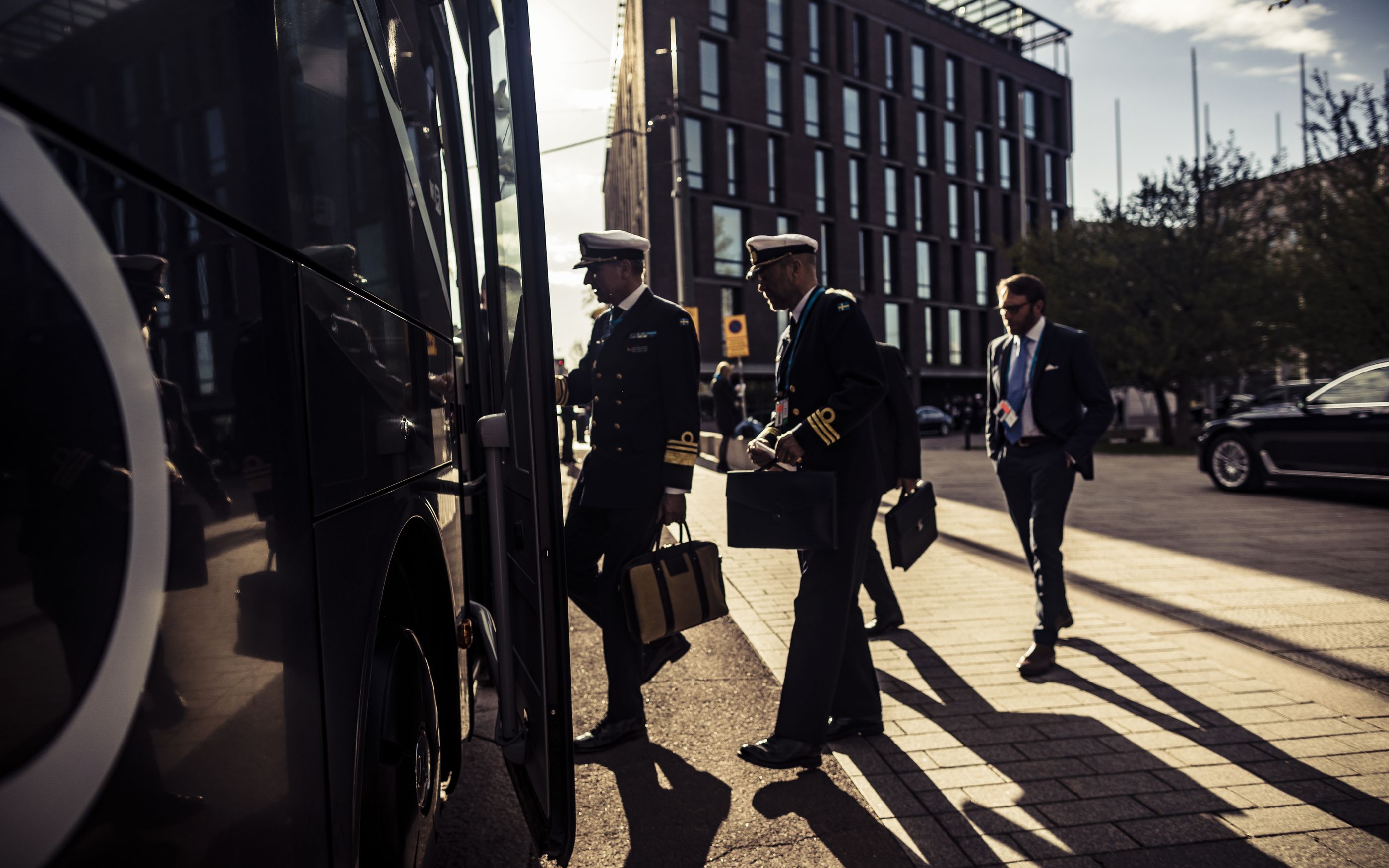
As the Arctic undergoes profound changes, its geopolitical importance is growing. Yet experiences of managing the risks and opportunities of an increasing great-power presence have been exchanged far too rarely between the Arctic and other maritime regions. With a Roundtable on Arctic Security in Helsinki, Finland, held alongside the Arctic Council ministerial conference in Rovaniemi, the MSC sought to mark a turning point.
As confidential meetings of no more than 40 participants, held throughout the year on the sidelines of international events around the world, these gatherings provide a platform for dialogue among senior international representatives of governments, armed forces, intelligence services, research and civil society.
This year’s invited guests included Pauli Niinistö, President of Finland; Timo Soini, Finland’s Foreign Minister; Clive Johnstone, Commander of NATO’s Allied Maritime Command; Sergey Kislyak, a member of the Russian parliament’s Federation Council and former ambassador to the United States; and selected representatives of international intelligence services.
‘We have much to gain from drawing on the experience and knowledge of Nordic partners: they have a wealth of experience in operations at northern latitudes and are highly skilled, technologically advanced neighbours whose forces are also interoperable with NATO troops,’ Munich Security Conference Chairman Ambassador Ischinger said during the Roundtable on Arctic Security in Helsinki.
Roundtable participants also emphasised Arctic cooperation as a model for other regions. They described the constructive dialogue maintained by Arctic states as a welcome contrast to growing tensions, especially between major powers. Despite confrontation on many other fronts, Arctic states—including the United States and Russia—cooperate across a range of areas, including maritime safety, environmental protection and meteorology. In doing so, they show that small shared steps are possible, and that the trust these generate may even help ease tensions among many political actors.
The Arctic is part of a changing geostrategic environment. Warming trends have stimulated growing interest, including from non-Arctic states, in the region’s abundant natural resources and potential maritime trade routes. The task now is to actively shape the future of the world’s smallest ocean in accordance with shared values and interests.